Download PDF Bursts: The Hidden Pattern Behind Everything We Do
Those are some of the benefits to take when getting this Bursts: The Hidden Pattern Behind Everything We Do by on-line. However, exactly how is the method to obtain the soft file? It's really ideal for you to see this web page due to the fact that you could get the link page to download guide Bursts: The Hidden Pattern Behind Everything We Do Simply click the link offered in this article as well as goes downloading. It will certainly not take much time to obtain this publication Bursts: The Hidden Pattern Behind Everything We Do, like when you should go for publication establishment.
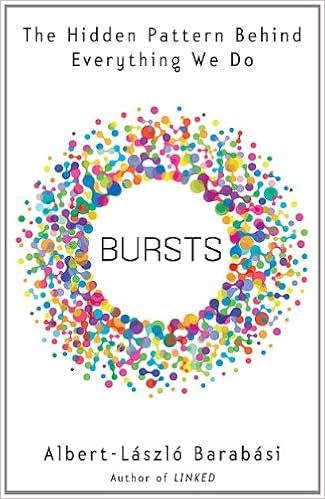
Bursts: The Hidden Pattern Behind Everything We Do

Download PDF Bursts: The Hidden Pattern Behind Everything We Do
Welcome once again, we constantly welcome the visitor to be in this website. Are you the novice to be viewers? Never mind. This internet site is actually offered and suitable for everyone, Moreover, the individual that actually requires motivations and resources. By this problem, we always make updates to get whatever brand-new. Guides that we collect and also offer in the listings are coming from several resources inside as well as beyond this country. So, never be question!
When you now feel bemused to attempt the particular publications to check out, Bursts: The Hidden Pattern Behind Everything We Do can be an option. This is a clever choice for you. Well, guide can lead you to earn much better options and also alternatives. After getting the book, you will not be bemused once more to discover the best publication. Publication is among the windows that open the globe. This publication is additionally exactly what you need in order to accompany you.
It won't take more time to purchase this Bursts: The Hidden Pattern Behind Everything We Do It won't take even more cash to print this book Bursts: The Hidden Pattern Behind Everything We Do Nowadays, people have been so smart to use the innovation. Why do not you use your kitchen appliance or other device to save this downloaded and install soft data book Bursts: The Hidden Pattern Behind Everything We Do This means will let you to consistently be gone along with by this publication Bursts: The Hidden Pattern Behind Everything We Do Obviously, it will be the most effective buddy if you read this publication Bursts: The Hidden Pattern Behind Everything We Do until completed.
We discuss you also the method to obtain this book Bursts: The Hidden Pattern Behind Everything We Do without going to the book store. You could continue to go to the link that we give and prepared to download Bursts: The Hidden Pattern Behind Everything We Do When many people are active to look for fro in the book establishment, you are really easy to download and install the Bursts: The Hidden Pattern Behind Everything We Do right here. So, exactly what else you will choose? Take the inspiration here! It is not only giving the right book Bursts: The Hidden Pattern Behind Everything We Do yet likewise the ideal book collections. Right here we always offer you the most effective and also most convenient way.
Review
"In Linked, Barabasi showed us how complex networks unfold in space. In Bursts, he shows us how they unfold in time. Your life may look random to you, but everything from your visits to a web page to your visits to the doctor are predictable, and happen in bursts." -Clay Shirky, author of Here Comes Everybody "Barabasi is one of the few people in the world who understand the deep structure of empirical reality." -Nassim Nicholas Taleb, author of The Black Swan "Barabßsi brings a physicist's penetrating eye to a sweeping range of human activities, from migration to web browsing, from wars to billionaires, from illnesses to letter writing, from the Department of Homeland Security to the Conclave of Cardinals. Barabßsi shows how a pattern of bursts appears in what has long seemed a random mess. These bursts are both mathematically predictable and beautiful. What a joy it is to read him. You feel like you have emerged to see a new vista that, while it had always been there, you had just never seen." -Nicholas A. Christakis, M.D., Ph.D., coauthor of Connected: The Surprising Power of Our Social Networks and How They Shape Our Lives "Bursts is a rich, rewarding read that illuminates a cutting-edge topic: the patterns of human mobility in an era of total surveillance. The narrative structure of Barabßsi's provocative book mimics the very pattern of bursts, as abrupt jumps through the lives of a post-modern sculptor, a medieval Hungarian revolutionist, and Albert Einstein eventually converge on a single theme: that our unthinking behaviors are governed by a deeper meaning that can only be deciphered through the brave lens of mathematics." -Ogi Ogas, Ph.D., and Sai Gaddam, Ph.D., Boston University "Barbasi, a distinguished scientist of complex networks, bravely tests his innovative theories on some historic events, including a sixteenth-century Crusade that went terribly wrong. Whether or not the concept of "burstiness" is the key to unlocking human behavior, it is nonetheless a fascinating new way to think about some very old questions." -Thomas F. Madden, Ph.D., Professor of Medieval History, Saint Louis University, author of The New Concise History of the Crusades
Read more
About the Author
Albert-László Barabási is a pioneer of real-world network theory and author of the bestseller, Linked: How Everything is Connected to Everything Else and What It Means for Business, Science, and Everyday Life. At 32, he was the youngest professor to be named the Emil T. Hofmann Professor of Physics at the University of Notre Dame and has won numerous awards for his work, including the FEBS Anniversary Prize for Systems Biology and the John von Neumann Medal for outstanding achievements. He currently lives in Boston and is Distinguished Professor and Director of the Center for Network Science at Northeastern University.
Read more
Product details
Hardcover: 310 pages
Publisher: Dutton Adult (April 29, 2010)
Language: English
ISBN-10: 0525951601
ISBN-13: 978-0525951605
Product Dimensions:
6.3 x 1.1 x 9.3 inches
Shipping Weight: 1.2 pounds (View shipping rates and policies)
Average Customer Review:
2.8 out of 5 stars
63 customer reviews
Amazon Best Sellers Rank:
#630,343 in Books (See Top 100 in Books)
I find my own experience with this book well described by other reviewers in the 2-star rating. The only concepts I learned here were that prioritized queues can give power law distributions of waiting times, and that Levy flights can produce non-recurrent random walks even in 2 dimensions. That's not a lot, and I could have found such concepts in scholarly publications for free. But you never know how you are going to stumble across a useful new idea, so maybe for this alone the price of the book was worth it.I enjoyed the Hungarian history, but the constant interruptions "for a message from our sponsor" (i.e. Barabasi) made it less like D.W. Griffith's Intolerance (with multiple parallel plots) and more like a TV show where they build suspense only to cut to the commercials every three minutes. The only way I finished this book was to jump through it to read the Hungarian history thread uninterrupted, and then go back and pick up the science.There were a lot of off the wall characters paraded through the book, so it had interest as a shop of curios.But I would have to say that whatever actual assertions Barabasi is making about "the hidden pattern behind everything we do", I am not persuaded.
Spends a lot of time regurgitating the history of early Hungary and Transylvania (his homeland) for reasons that never do become particularly clear. After his book, "Linked In" I was expect the same style and tone it was disappointed. I kept reading thinking that at some point Barabasi would tie it all together, but if he did that, I certainly missed it. Ended up not really be sure why he wrote the book. Some of the claims he made in the beginning certainly don't come to fruition. A disappointment.
I thought Albert-László Barabási's first book, "Linked: How Everything Is Connected to Everything Else and What It Means," was excellent (see my 4/18/10 review), so I looked forward to reading "Bursts" with great anticipation, hoping that he was going update us on all the interesting things he learned in the intervening 8 years (especially related to biomedicine and cancer). Instead, having just finished "Bursts," it's hard to convey how disappointed I am.While "Linked" presented plenty of solid and useful science in an appealing format, "Bursts" has minimal scientific content and I learned almost nothing. The only significant idea Barabási presents is that the time-spacing of many events in the natural and artifical worlds follows a power law distribution, which means that events have some tendency to cluster into "bursts," although very widely spaced events can also occur, since power laws have "long tails" rather than dropping off exponentially (as Barabási himself acknowledges in passing, "bursts" is a somewhat misleading term, since power law distributions are continuous, not dichotomous). But Barabási doesn't offer much explanation for the ubiquity of these power laws, nor does he offer useful insights regarding their implications.He does try to argue that awareness of these power laws will eventually enable precise prediction of human behavior, but this is simultaneously both obvious and wrong (and it's telling that Barabási appears to be unaware of the seminal work of Quetelet on this topic). It's obvious because we already know that people are necessarily creatures of routine and habit, so where we are and what we're doing will often be predictable. But it's wrong because, like the weather, our lives also involve volatility and bifurcation points, such that much that's important about our individual and collective lives will remain unpredictable. I've experienced this in my own life in profound ways, and so have you (think back, and you'll recall some pivotal moments).Most of the book is actually taken up by a discussion of an episode from Hungarian history of the 1500s. This may interest Barabási for personal reasons, and perhaps it satisfies some urge to be a historian or novelist (which he apparently has a knack for), but it has no place in this book. I kept waiting for this plot and other plots interwoven throughout the book to all gel together in the end, but they never did -- I feel like I was waiting for Godot.Overall, this book was a waste of money and (more importantly) time. The only redeeming feature is that I was able to read it quickly (three days), but that's small consolation. I really don't know what Barabási was thinking. I must also add that I was partly swayed to read this book by the endorsement from Nassim Nicholas Taleb on the back cover; that endorsement has unfortunately harmed Taleb's credibility in my eyes.
The author takes a very circuitous route in trying to promote a rather simple idea: that despite occasional "bursts" in mainly human activities, the activities have predictable "patterns", referred to in his subtitle.The idea unfortunately rests on absolute determinism, the presumption that every event is governed by inviolable laws of nature, theoretically enabling complete prediction of the future if all preexisting conditions are known. The author recognizes, of course, the role of statistics and its mathematical utility for successfully estimating many future occurrences. But he proposes additional "power laws", somehow independent of other, mathematical, laws, in keeping with the assumption of a law-based nature.He nevertheless points to statistical patterns in even regularities interrupted by "bursts" or "outliers", returning us to probabilistic mathematics. The deeper issue is (bypassing here the famous uncertainty principle): are all events in nature truly predetermined by preceding ones? The author makes reference (p.105) to free will as complicating everything, and suggests (pp.253-4) that by "quantifying everything we do" science is "forcing us to rethink everything we take for granted, from free will to our privacy".Does "quantifying everything we do" dispose of free will? There appears no such logic. We still seem to possess the power of choice, regardless of whether there are similarities in our actions because of similar circumstances, which allow statistical predictions. The irony is there is a contradiction in the deterministic hope for predictability of human action and for corresponding improvements of our lives. The author regrets (p.258) that, unlike in weather forecasting which has improved with increasing knowledge of underlying conditions, "to predict conflicts and wars in the hopes of helping us one day avoid them altogether" has failed, and he wonders: "Have we matured enough to trust our predictive abilities?"What escapes him is that should determinism allow us "to predict conflicts and wars", it equally prevents this from "helping us one day avoid them altogether". If the future is determined, we have no choice about its course.The author embellishes his rather narrow argument for eventual better predictability of all occurrences (an argument unfortunately endlessly elaborated by him and others in prestigious scientific journals) with intriguing stories both present and past, which somehow involve that argument. He is evidently a good storyteller, although his acknowledgements list many assistants. Many particulars seem gratuitous though. He gives the impression of a Hungarian chauvinist, writing, e.g., the dedication ("To my children") in Hungarian. Yet it seems unsuitable for children (I really don't know their age), and unnecessary, to resort to citing (p.169) obscene language in relation to a Hungarian accent, or to describe in detail (pp.265-6) the gruesome execution of a legendary Hungarian figure.
Bursts: The Hidden Pattern Behind Everything We Do PDF
Bursts: The Hidden Pattern Behind Everything We Do EPub
Bursts: The Hidden Pattern Behind Everything We Do Doc
Bursts: The Hidden Pattern Behind Everything We Do iBooks
Bursts: The Hidden Pattern Behind Everything We Do rtf
Bursts: The Hidden Pattern Behind Everything We Do Mobipocket
Bursts: The Hidden Pattern Behind Everything We Do Kindle

Tidak ada komentar :
Posting Komentar